
Harmonisation with the International Treatment of Common Cause Failure
An initial overview of the most widely-used methods for assessing common cause failures highlighted that no one model is superior across all possible scenarios. The choice of CCF approach depends on knowledge of the system under analysis, the availability of applicable data sets and whether the analyst is conducting conservative screening analysis or attempting to provide best-estimate quantification.
A follow on workshop, supported by an industry-wide questionnaire, identified a number of topic areas where further research and/or guidance was considered generally beneficial to the application of CCF in safety analysis.
Project Outputs and Further Reading:
Guidance for coupling factors assessment. Although there is a consensus on the factors that are considered for deciding whether or not to couple specific components, in practice there can be grey areas when trying to apply the guidance. A technical note has been produced to highlight relevant guidance to aid the determination of coupling factors.
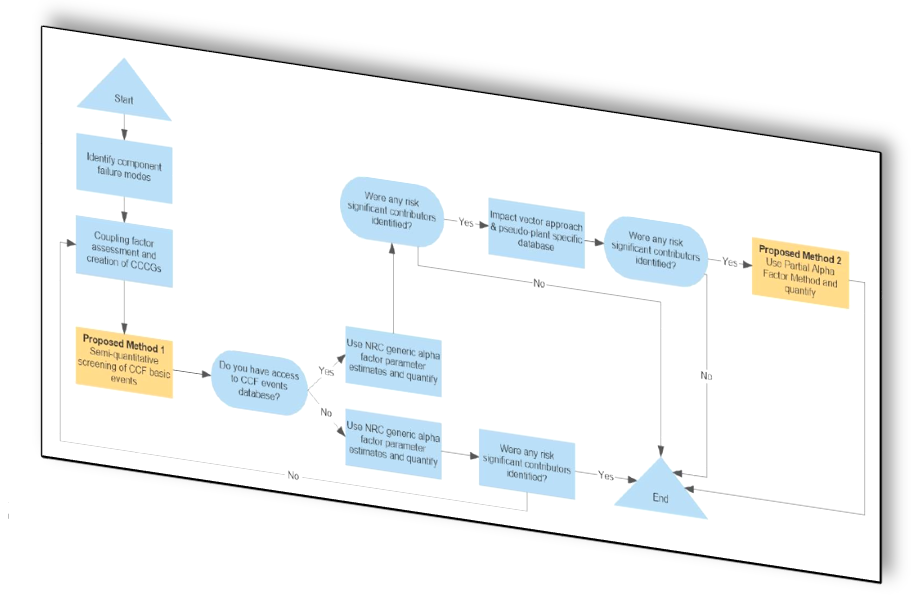
Guidance for application of qualitative vs quantitative models. A technical note explores the benefits of the two approaches (i.e. crediting defences using the Unified Partial Method, and the rigorous, statistical approach of Alpha Factor) and suggests how these could potentially be combined.
A roadmap for future CCF research. Resource constraints limited the extent of research that could be pursued in this CCF project. However, the CCF topic areas identified as being worthy of further development have been documented in a technical note together with an outline of how this development could be undertaken.
UK based safety case practitioners need to take due account of international best practice in the field of Common Cause Failure analysis. The reasons for this are twofold:
- so that reactor designs developed in the UK and imported reactor designs, submitted for licensed operation in the UK, can be assessed consistently, and
- because using appropriate qualitative and quantitative CCF methods is necessary to achieve optimal safety features and risk mitigation strategies in new reactor designs.
The project has provided clear guidance on knowledge gaps and opportunities for future research and development so that the UK nuclear industry can better allocate resources and investments to develop common future tools and approaches.